Professional Practice
For my second photo essay, I followed two patients of a neurological rehabilitation centre on a typical day. Given the sensitive nature of medical privacy, it was important for me to ensure the patients' consented to my invasion of their privacy.
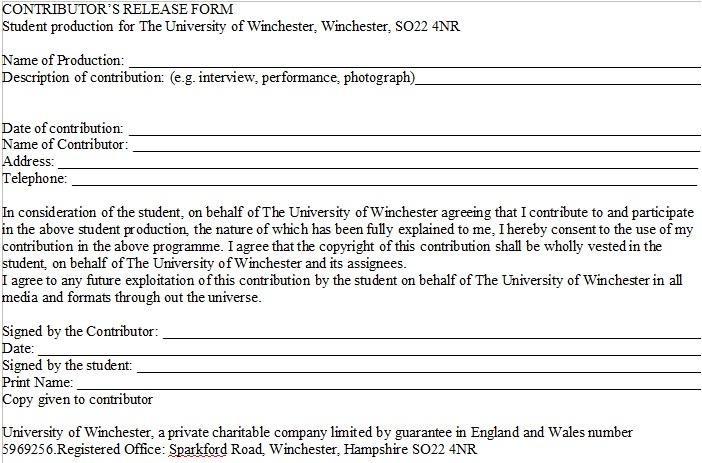
So starting with a template, and my learned knowledge of privacy law, I drafted my own release forms to be signed by each patient, and anyone else whom I photographed, such as staff or patients' family members. I would keep one as a record of consent, and the participant would keep a copy for reference. As the point of the form was ethical consideration, I kept it brief and simple, avoiding complicated legal jargon.
I printed twenty forms, including relevant and controllable details on some, and leaving others to be filled in at the time of signing to cover unforeseen eventualities.
Copyright
To ensure my online and offline work is kept safe from unauthorised copy, I drafted my own copyright notice, to be placed at the foot of each piece of work I produce. To ensure the copyright is valid, I must send myself a recorded copy of the work in a sealed envelope and keep it sealed when I receive it. All work on this site is also covered by a separate document drafted by producer Jess Hallett, as shown here.
Role Research
As I was initially unfamiliar with the idea of writing for documentary, I undertook some initial research into what kind of work would be necessary. Writing a documentary seems counter-intuitive at first. After all, isn't a documentary supposed to simply DOCUMENT real events? How can you possibly script reality? Those were my first thoughts upon taking on the role of writer for our film, but with a little research, I discovered what writing for a documentary can entail.
As Bill Nichols explains early on in Representing Reality, although documentary may claim to exhibit Plato's 'truth and reality,' every form of cinema merely presents images of it, 'imitations,' that can only hope to 'illustrate' examples of it. And therein lies the power of documentary, as a respected medium, to persuade and convince.
The writer then, takes on the responsibility of directing this power, choosing where to focus it, and to what end. They therefore need complete understanding of the proposed content, direction and argument, along with comprehensive background knowledge of the subject.
From the research I've done, it seems the usual way of writing for documentary is to first create a preliminary/pre-shoot/shooting script which acts as a 'conceptual map for your shooting journey.' Built from the research into the topic, it should serve as a reminder of the film's desired destination, leaving room for interpretation.
This will be followed by the writing of a shot list, a more specific list of the shots desired to best convey the film's intended message, as defined in the pre-shoot script. Paper-edits may also be written alongside shooting, to record tape numbers or time-counters to aid editing.
According to film-maker Marino Colmano, documentary writing can strive to establish characters and chronicle their journeys and conflicts just as well as dramatic writing, and is usually at its best when it does. These characters can then lead the narrative within the documentary structure.
© (12/12/12) (G. Blake). All Rights Reserved.
