- Critical Reading Reviews -
On this page we have reviewed each week of extra class content displayed on the Learning Network and have analysed and written about what we have learned.
Week 1...
Introduction to the module...
For the first week we were put into the practice of how to start off our module work through researching various topics and developing our individual initial documentary ideas. We were also given an introduction to the U-Doc festival where our documentary will be screened and judged, and were shown examples from previous years. We were also shown the difference between a promotional piece of work and a documentary to help clarify what we needed to produce, along with the assessment requirements. The PDF gave suggestions of how to get started, and also how to work on promoting our group’s documentary idea. The PDF also showed and explained how last year’s winners had won and suggested ideas of how to best advertise our own.
We were also introduced to Yola, a free website building site where we could create our own website for the documentary module in order to show our research and other ideas as well as examples of good practice from previous years.
Learning copyright from the PDF ‘copyright witness’ was extremely important to ensure that any work we publish online would be protected. We found that researching and copying information and images would only be okay if the owner gave us explicit permission. For example, on Toby Weller’s page he is currently waiting on permission from John Harrison Photography to show examples of John’s work.
We also made our own copyright statement to put on every piece of work we produce- our films, photos/images and website (which is included as a literary work). This will not only cover us right now, but will also last for seventy years after the director, photographer or author dies.
© (27/11/12) (G. Blake & T. Weller). All Rights Reserved.
Week 2...
Ying and Yang Theory
The Yin and Yang theory follows a set of guidelines and is found in a lot of professional photography. It is, in essence, deconstructing each element of the image. The idea is that while creating an image, one must keep in mind the connectivity between the elements of that image. Nothing we create or implement into an image should be by accident, the various parts of the image must compliment each other, hence the term "Ying and Yang."
There are several elements to this theory. One is the contrast been light and dark, (much like the Ying and Yang symbol) which can be used to highlight a character of subject to encourage the viewer to inspect that particular part of the image. This can also be used to put the image in a positive or negative light, so to speak. Another element of this, similar to the contrast of light and dark, is the relationship between the background and foreground. The balance between these, as to where to put the characters is intregal to the composition of the image.
The juxtaposition of two characters of items in the image when positioned near or next to each other is also very important in this theory. They must be placed in such a way that it encourages the audience to think about the items and why they are contrasting.
Is when two subjects are positioned next to each other within the image to create a comparison between the two and to encourage the viewers to think about the subjects in how and why they are differing. Juxtaposition can be used in absolutely anything in regards to photography, it can relate to a contrast in objects, location, colours, shapes and living things. The beauty of using juxtaposition in an image makes the two subjects more distinguishable and recognised in terms of the meaning created.
Week 3...
PDF: 'Undisclosed recipients: Documentary in an Era of Digital Convergence' - Sharon Lin Tay & 'Database Documentaries and the Internet' - Dale Hudson
These two essays examine how documentary has changed and developed with the application of digital technology and the new methods of conveyance it has introduced.
The first starts by acknowledging documentary as the search for truth, but questions whether it can ever really exist in an age of political manipulation of media. Where does fiction end and fact begin? Is there such a thing as 'fact' in relation to film; a highly manipulated medium?
It then introduces Michael Takeo Magruder's online works {transcription} and [FALLUJAH. IRAQ. 31/03/2004], and how they demonstrate media over-saturation, to the point where even the most important and relevant news information becomes a meaningless collage of scrambled images and white noise. This raises the danger of 'mediation without context,' placing immediacy and currency of events and facts before comprehension and the chance to build accurate knowledge. In this way, digitisation can result in disassociation of the signified from its signifier.
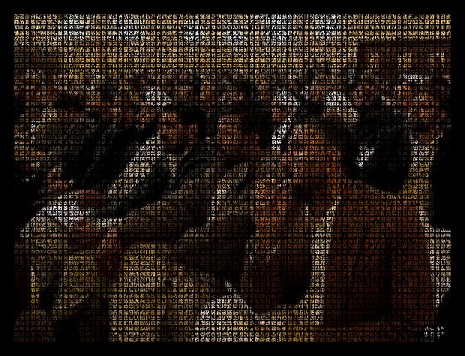
The essay then looks at how TV news appears to be losing sight of documentary's search for truth, in favour of delivering packets of commercial product, and even actively hiding it for the sake of politics.
Looking at Christina McPhee's 'La Conchita mon amour,' the essay then looks at the way digital documentary process can represent trauma more effectively than traditional media by presenting a 'selection and combination' of resources. The unseen, hidden and emotionally subjective aspects of trauma are juxtaposed with the factual and objective aspects to create a poetically jarring representation of the traumatic event and the destruction and anguish it caused.
This first essay concludes with a quote from Vivian Sobchack regarding the common portrayal of death in documentary as violent and unnatural, rather than a fact of life, because of society's unfamiliarity with the latter. This is perfectly illustrated by many mondo films, and their obsession with and fetishization of death.
The second essay focuses on database (web/multimedia) documentary, and how it allows for new and open modes beyond the familiar, such as collaborative and interactive. This moves the media from a push structure (supplying) to a pull (gathering, sharing) allowing for open meaning and discussion of. After all, digital recording does not need to be continuous, linear and chronological, as with film. It can become a network of discourse, rather than a singular entity. Digitality allows meaning to become 'a constant process of accumulation'
It provides the example of Eduardo Navas' Goobalization, which documents how the Internet, or at least its largest component, Google, controls representation and mediation through its ordering of search terms.
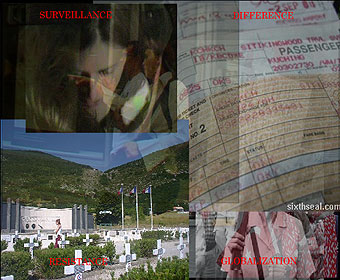
And also Mariam Ghani's 'Kabul: Reconstructions,' an interactive documentary and dialogue project that can offer multiple perspectives on its subject, and an interaction between them.
While these documentaries are based in familiar, traditional modes such as the expositional and observational, their scope for collaborative involvement and freedom from restriction, allows digital documentaries 'potentially endless recombinations' of them.
These essays demonstrate the changing nature of documentary in an age of multimedia-convergence, and how very different they can be from traditional forms. We should take note of the freedom this gives us to experiment with our documentary, and find original ways to tell our story.
© (25/11/12) (G. Blake). All Rights Reserved.
This paper takes a psychoanalytic look at the difficult relationship between photography and ethical responsibility. While documentary has claimed the noble goal of 'awaken[ing] social conscience,' our increased exposure to ethical issues has done little to change our views on them for better or worse, particularly regarding suffering and atrocity, as this article primarily discusses. This suggests that photography may be an ineffective medium of affecting responsibility.
Further, Susan Sontag suggests in her collection of essays, On Photography, that the very act of photographic something removes any notion of responsibility, and in fact shows explicit acceptance of the subject or action occuring and encouragement for its continuation, marking it as an absolute ethical failure.
Should we encounter any such scenes when making our documentary, we will have to remember this, and decide if we are willing to be morally complicit.
Photographs of suffering and atrocity show an audience a distant issue that they naturally want to assist with, but physically cannot. This will result in a certain level of personal anguish, and it is up to us to decide how much is necessary to show in order to get the point across. Any more would be deemed ethically unnecessary and cruel.
Conversely though, we have the example of Charles Simic who, as a child in 1944, didn't recognise the kind of war he saw in photographs as the same as that happening all around him. Looking back, he says he was 'bored' by atrocity, seen as a typical first response. Looking back though, the distance provided by photographs allows him to better come to terms with and understand the atrocities.
If appropriate, we can use this effect of physical or temporal distance with our audience to elicit an emotional response that is contemplative and reassuring, rather than viscerally traumatic.
Therefore photography can offer a 'compact description of reality,' free from psychical interpretation. We must remember also, that accurate captions and descriptions are vital to preserve context, which can otherwise be exploited for bias.
© (25/11/12) (G. Blake). All Rights Reserved.
Week 6...
Reality bites
- documentary in the 21st Century RR File
Real reality
documentary film PDF
Looking at these two articles, they not only make me think about the truth of documentary, but they also give me much deeper understanding about the relationship of reality and the documentary film. In this critical reading, I will discuss the truth of documentary from three points of view.
“Documentary is a non-fiction that deals with facts and real events as opposed to fiction, and is concerned with real people, places and events.” Vivienne (2007).
According to the definition of documentary by Vivienne (2007), it can be known that the documentary film relies on reality. In fact, many documentaries misunderstand or misuse the word of ‘Real’, and there are two main issues regarding this. Some documentaries over use the ideal of creating the ‘real’, and some directors fail to consider the aesthetic of their documentary because of this. In doing so, directors simply record real events and capture the moments. However, some documentaries were completely constructed by directors, using cameras, editing etc. In this instance, the documentary does not tell the “truth” rather a fictional event parading as the “truth.”
It is obvious that reality has a marked impact on the way of making documentary, and there are several sides that could help to understand the relationships between reality and documentary. Firstly, the contents of documentary should rely on the physical reality and represent reality as well. There is a viewpoint form the book called ‘Theory of film: The Redemption of Physical Reality’ by Kracauer (1960). It emphasizes that the image contents and visual contends of documentary should be made based on physical reality. That means its sound and image contents of documentary used to exist, before they are captured by the cameras. Therefore, the truth of documentary would appear during the recording. Having said this, however, this viewpoint has its own limitations, as the truth of documentary is relative, not absolutely real.
In the first place, there would have interaction between directors and subjects. Subjects would appear to be conscious in front of the cameras, and aware of their presence, so the documentary might not be entirely presenting physical reality. Additionally, the truth affected by directors, because after filming, editing, voice over-narration might be employed due to the aesthetic reasons. Taking animal documentaries for example, when directors edit the clip, they prefer to use the scene, which looks dramatic and stimulating to audience. However, these scenes might not represent of animal’s habits and their daily lives.
The essential truth can be almost understood as ‘spirit likenesses in ancient papers’. In traditional literature and art theories, this is the category of reality typification. It emphasizes that the documentary truth should be a kind of reality that reflects real life. This is not demanding to the documentary which is form of art. The problem is, simply emphasizing the ‘essential truth’ does not correctly answer the question; ‘How to express real life essence in documentary’. It also cannot distinguish the documentary from feature film and literary novels.
As a crucial type of observational documentary technique, ‘direct cinema’ emphasizes that the requirement that it must see very clearly to what is happening like a fly-on-the-wall, and will not affect its appearance and development. If the documentary can be fully made according to this, somehow we can claim that it is able to completely ‘restore and repeat’ some objective life content. In fact it is almost impossible to find complete things in the real world, even a fly on the wall style of crew, may cause the distraction and other circumstances of staff. Cameras and directors are inevitably involved in the documentary, so their effect to those who being filmed and their behaviours cannot be completely eliminated. It also means a certain degree of interference, influence and change is inevitable while capturing the process of development.
In conclusion, the truth of documentary is reality. Therefore truth is relative, is the reality processed by choreographers. The guarantee of its authenticity is linked with the morality and conscience of the creators. It is impossible to pursue an absolute truth, the ‘pure objective’ of documentary does not exist.
© (04/12/12) (A. Zhu). All Rights Reserved.
Week 7...
PDF: 'Honest Truths: Documentary film-makers on ethical challenges in their work' - Patricia Aufderheide, Peter Jaszi, Mridu Chandra
This study uses the results from forty five interviews with established film-makers to reveal the ethical challenges they have experienced in their work, and their opinions on the position of ethics in the industry.
The interviews showed that ethical concerns were important to documentary makers because of their position of power over the subject and the audience. The report acknowledges the respect audiences have built for documentary, particularly since the 1990s, and the responsibility the film-makers now feel to live up to it, especially regarding political content.
We will also be subject to this respect in the making of our film, and must attempt to honour it as best we can.
Unlike other media, there is no standard ethical practice for documentary films, so issues must be dealt with case by case. Conflicts with financial pressure and artistic integrity are highlighted and viewed as an inevitable problem to be faced.
Commercial pressure can lead to shoddy practice and the lowering of standards, including faking or exaggerating content to enhance its dramatic appeal.
The interviews suggest that the film-maker's primary concern should be to respect and protect the subject of the film, for they have given up their time and story for your benefit. 'Do no harm, protect the vulnerable' was generally agreed to be a good standard, but of limited obligation if it was to compromise artistic value.
As animals will be the subject of our film, we have particular responsibility to ensure their welfare and avoid unnecessary exploitation.
After all, a film-maker's attitude determines their reputation, which can limit future activity. Some give the subject the chance to see the film first, to make sure they are satisfied. This makes them comfortable, allowing further access.
Conversely however, it was deemed important not to let the subject control the direction of the film.
As regards payment; while it could taint the honesty of the subject or the film, it was largely seen as only fair to cover expenses.
It is also seen as important to extend this professional relationship to the viewer, as the film-maker's allegiance will probably switch to them in the latter part of the process, when friendships with subjects are no longer as important.
The report illustrates this by acknowledging that the original 'truth' may become secondary to a 'Higher Truth' that may require a different strategy to convey.
It also considers the power of editing and framing in shaping the perception of ethics, and that [re]staging of events, whether trivial or for reconstruction is generally accepted as inevitable, but good to acknowledge on-screen.
Likewise, use of archive pictures and/or film may be acknowledged as accurate or representative; or not at all if it helps the story and is of no major concern.
In short, ethical concerns are taken seriously because film-makers are aware of their responsibility, and owe a lot to their subjects, so not treating them ethically would be self-defeating.
The freedom to self-regulate in this regard is liberating, but should not be taken for granted, and it is an issue that requires continuous discussion and input if it is to remain credible.
© (12/11/12) (G. Blake). All Rights Reserved.
Week 8...
Aesthetics of realism
Digital technology has often been accused of making documentary representations too complicated, and that it has been influencing new aesthetic ideals in the genre, which blur the line between fact and ficiton. Both the growth in technology and media convergence alongside it have understandably changed the way in which documentaries are proposed, shot and edited.
However, it is not just the technical aspects of the film making that is coming under critism in new documentaries. Documentaries today, somewhat understandably, are often becoming accused of not being documentaries at all. I have already covered John Grierson in my research and can see how modern documentaries would not be appealling to him, a man who criticised Russian cinema frequently for being more eager to entertain their audience rather than educate them. Documentaries today are often quirky, comical and have celebrity focused content. A lot of "documentaries" released today even come with admissions that some of the the events about to be potrayed in the film are staged. For example, the purported "documentary" called "The Only Way is Essex" comes with a disclaimer - "Some of this has been set up purely for your entertainment" a notion that certainly would have been appalling to Grierson.
However, I believe that it is not exclusively a modern way of making a "documentary". Nanook of the North, for example, released in 1922 by Robert J. Flaherty, was exposed to have so many set up scenes and a vast amount of inaccurate facts about Inuit life, that it was exceptionally close to being entirely fiction! I understand that Landesman has noticed a pattern in the fact that modern documentary makers tend to want to exhibit their talents for making a film aesthetically pleasing, however; this was happening in 1922 also, when Flaherty was more interested in making an aesthetically pleasing film than portay Inuit life accurately in his film.
© (07/12/12) (L. Hart). All Rights Reserved.
Week 9...
Screenings of Werner Herzog and Nick Broomfield...
We looked at Nick Broomfield and his work this week. We focused on the documentary concerning the murders of rappers Tupac and Biggie. The introduction to the story of Tupac and Biggie uses archive photos to tell the story, along with constructed police sounds and recorded voices. Broomfield’s interview of Russell Poole (the ex-cop) is raw and unedited, creating an almost ‘decisive moment’ feel to it as Poole’s responses and actions were unpredictable and unplanned at the time.
The voiceover of Broomfield along with himself appearing in shot, adds a stronger narrative and guidance for the audience of what had happened- a good example of the participatory mode of documentary making. When Broomfield is trying in get an interview with Russell Poole he adds to the footage through a voice over: ‘Russell could talk about the case all day but this is all they would allow him to say’.
Broomfield is seen to be confronted by the police in a sudden and unedited shot to help articulate that his interviews and footage is not faked. This gives much more depth to his work. The use of realism in the documentary is very similar to that of Werner Herzog and his techniques whilst using the performative mode style.
During the interview with Tupac’s father we also hear Broomfield’s voice, a technique which is also used in ‘Grizzly Man’ by Herzog. The use of unedited footage and voice over combined creates extra meaning, with the voice over anchoring the images and making the sentiment behind them clearer to the viewer. By Broomfield openly participating in the documentary, he becomes a huge part of the piece, guiding the audience through his experiences of a cover up of the killings of Biggie and Tupac.
Soundscape
Listening to soundscape, we learned that a combination of different sounds could help to create an environment. When raising the amount of sounds together or adding more you can create an immersive environment. From this we have learned that creating a new sound all together can be done to add to a documentary. An example would be the ‘Tupac and Biggie’ documentary. The intro has a clear soundscape, which combines together with the main footage to make us, the audience, feel that the event of the death of the rap stars has truly happened. This is more defined as a reconstruction with a great use of sounds to set the scene/environment, making the content of the documentary more potent. Using soundscape will be really important in order to create the right environment sound in order to evoke different emotions from the audience for our documentary.
My Friend
We also watched ‘My Friend’ - a documentary that shows Werner Herzog’s drama films with actor Klaus Kinski and their productive yet strained relationship. This shows two men who both have passion, flare, answers to all the questions but two similar people who want to be dominant throughout. We take a journey as part of the crew as we see the anger of the two heavy weights wanting to be on top.
We, the audience, learn how from capturing a journey you can also capture someone’s softer side. The ending that Werner Herzog uses shows how gentle Klaus Kinski really was, creating sympathy for his character within the viewer.
Rogue Film School
We were given an example of where we should be aiming to go as documentary makers, finding ways to further our own abilities in our documentary work. This school is taught by Werner Herzog, which only a limited amount of people can join. Having an insight into places to go for the future really helps us understand more about what is needed to be learned and what experience gained to become better in the field of documentary making.
Cover letter for documentary
We were also taught how to construct a cover letter for our documentary projects. From the example already made, we could clearly identify the points that we would need to make clear for our contracts or organisations before filming the documentary. This would outline what our documentary is and the overall subject matter of the documentary.
A clear and concise cover sheet is what will be needed to help us gain Primaries for our documentary. This example proved to be really useful.
It is very important to have a signed cover letter before shooting a documentary as the resources/primaries may change their minds and without a signed cover letter we cannot us any material taken of them.
