- Professional Practice -
For my second photo essay, I followed two patients of a neurological rehabilitation centre on a typical day. Given the sensitive nature of medical privacy, it was important for me to ensure the patients' consented to my invasion of their privacy.
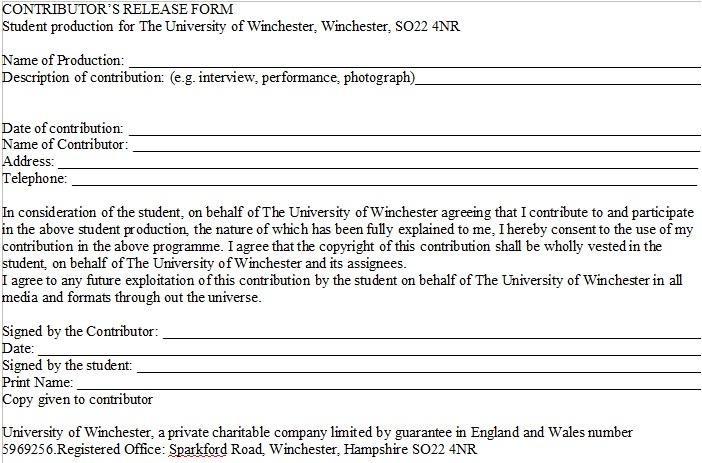
So starting with a template, and my learned knowledge of privacy law, I drafted my own release forms to be signed by each patient, and anyone else whom I photographed, such as staff or patients' family members. I would keep one as a record of consent, and the participant would keep a copy for reference. As the point of the form was ethical consideration, I kept it brief and simple, avoiding complicated legal jargon.
I printed twenty forms, including relevant and controllable details on some, and leaving others to be filled in at the time of signing to cover unforeseen eventualities.
Copyright
To ensure my online and offline work is kept safe from unauthorised copy, I drafted my own copyright notice, to be placed at the foot of each piece of work I produce. To ensure the copyright is valid, I must send myself a recorded copy of the work in a sealed envelope and keep it sealed when I receive it. All work on this site is also covered by a separate document drafted by producer Jess Hallett, as shown here.
Role Research
As I was initially unfamiliar with the idea of writing for documentary, I undertook some initial research into what kind of work would be necessary. Writing a documentary seems counter-intuitive at first. After all, isn't a documentary supposed to simply DOCUMENT real events? How can you possibly script reality? Those were my first thoughts upon taking on the role of writer for our film, but with a little research, I discovered what writing for a documentary can entail.
As Bill Nichols explains early on in Representing Reality, although documentary may claim to exhibit Plato's 'truth and reality,' every form of cinema merely presents images of it, 'imitations,' that can only hope to 'illustrate' examples of it. And therein lies the power of documentary, as a respected medium, to persuade and convince.
The writer then, takes on the responsibility of directing this power, choosing where to focus it, and to what end. They therefore need complete understanding of the proposed content, direction and argument, along with comprehensive background knowledge of the subject.
From the research I've done, it seems the usual way of writing for documentary is to first create a preliminary/pre-shoot/shooting script which acts as a 'conceptual map for your shooting journey.' Built from the research into the topic, it should serve as a reminder of the film's desired destination, leaving room for interpretation.
This will be followed by the writing of a shot list, a more specific list of the shots desired to best convey the film's intended message, as defined in the pre-shoot script. Paper-edits may also be written alongside shooting, to record tape numbers or time-counters to aid editing.
According to film-maker Marino Colmano, documentary writing can strive to establish characters and chronicle their journeys and conflicts just as well as dramatic writing, and is usually at its best when it does. These characters can then lead the narrative within the documentary structure.
- Graeme Blake
Health and safety
For our project we need to be professional and assess all of the risks and get into this mind of thinking like professional in the media industry. If the risk is too great the filming shoot may need to be cancelled or everyone will need to be pre-warned about any complications that may arise.
Copyrighting Work
Being aware of all copyright martial as well as protecting our intelligent property is thoroughly important throughout this project to avoid being sued in the process. Putting copyright law into practise is important throughout the project. Being professional at all times and being knowledgeable of copyright will aid our ability to get further in the media industry.
- Toby Weller
As a
sound designer, music copyright is vital significant that need to be aware when
they doing work. I attempted to focus music copyright and licensing for my
professional practice, as I have never take much time on considering about
music copyright In my country, the law of the music is not strict, and the
general public are lack awareness of music copyright and license. During the
research for music copyright, I realised how ignorance and unprofessional am I
as a sound designer.
The Importance of Music Copyright
In recent years efforts have been made to inform parishes of their responsibilities with regard to copyright requirements when reproducing the words or music of hymns for use in the liturgy.
Copyright protects the exclusive rights of copyright owners to reproduce or communicate their work. In these days of modern technology work can be reproduced in so many ways – by hand, photocopying, scanning, recording and filming a work, or by faxing, emailing, displaying electronically, broadcasting or putting it on an internet site. The right to perform a work in a non domestic context either live or by playing a recording, is also exclusive to the copyright holder, as is adapting it in any way such as making a musical arrangement or translating lyrics. Importantly Copyright provides for recognition and where appropriate, remuneration for any use or reproduction of a work.
Churches and other non-profit organisations are not exempt. It is imperative that parishes come to understand their legal obligations in this area as addressing copyright issues is neither optional, nor merely a rendering unto Caesar. Rather as Catholics we would appreciate not only the social justice dimension of ‘just remuneration’ but the respect due to the ‘intellectual’ property of others – both mirrored in Catholic social teaching.
People who can contact for getting permission
· For permission to photocopy printed music, the MPA can help to direct you to the copyright owner. You should provide as much information about the music as possible, including the title, composer, lyricist (if any), any arranger or editor and the date of publication or copyright line (usually inside the front cover or at the bottom of the first page of the music), together with the name of any publisher that you have for the edition. More about printed music.
· For permission to arrange works the MPA can help to direct you to the copyright owners. You should provide as much information about the music as possible, including the title and writer/s.
· For permission to use works in films, commercials or games you should contact the copyright owners. The MPA can help to direct you to them.
· For permission to record music you should contact PRS for Music.
· For permission to perform music live you should contact PRS for Music.
· For permission to broadcast music or include it in a cable programme service you should contact PPL and PRS for Music.
· For permission to perform a musical, opera or ballet you should contact the copyright owner/s directly. Again the MPA can help to direct you.
· For permission to play a recording of music in any public place you should contact PRS for Music and PPL. For any other usage not mentioned above you should contact the copyright owners directly. The MPA can help to direct you.
Sources: http://www.mpaonline.org.uk/%20how-can-i-find-copyright-owner-permission-use-piece-music
- What copyright exists in music?
There are principally 2 types of copyright to consider when we talk about music copyright.
- The traditional ©, ‘C in a circle’ copyright, applies to the composition, musical score, lyrics, as well as any artwork or cover designs, as all of these are individually subject to copyright in their own rights, (though when you register, you can include them all in a single registration provided they have the same copyright owner(s)).
- The second type of copyright applies to the sound recording itself, and is signified by the ‘P in a circle’ .
How does this work?
Suppose you want to record and sell your own version of Tchaikovsky’s 1812 Overture. This would not present a problem as Tchaikovsky has certainly been dead for over 70 years*, the work itself would now be out of copyright, and available as a work in the public domain. Provided you performed and recorded the work yourself, no infringement would have occurred. * Actual duration may vary due to national laws
You would however be justifiably annoyed if someone else simply copied your recording and started selling it themselves. This is where the copyright in the sound recording comes into play. Copyright law recognises the problematic nature of this situation which is unique to sound recordings, and gives sound recordings distinct protection in their own right that is separate from that in the underlying work. The copyright in the sound recording will run for 50 years from the year of recording, or 50 years from date of release if released in that time. Again actual duration may vary slightly from one country to another depending on national laws.
- Using the work of others
If you use samples of music by other authors in your work, ensure that you get permission to use the work before you attempt to publish or sell your work. Similarly, if you use loops or samples available via sample collections etc. ensure that these are licensed as free to use, or obtain permission first.
- Obtaining permission
If you need to get permission to use a piece of music, normally the best place to start is with the last know publisher for the work. They will certainly know how to get permission to use the work, (as they must have permission themselves), so they will certainly know who you would need to contact.
If the work is by an U.S. artist, you could contact the American Society of Composers, Authors and Publishers, BMI (Broadcast Music, Inc), or SESAC.
- Band members agreements
Where music is written as a group effort, we recommend that you draw up an agreement to clarify issues, such as which rights belong to which member, and how royalties would be distributed in the event that members of your group leave.
For successful commercial bands, incorporation is also an option. As with a normal incorporated company, the band members would own shares in the band/company. In this situation, a band member would typically sell his shares to the other members if he decided to leave.
- Does copyright protect a band name?
Copyright does not apply to names, neither will it apply to single phrases or slogans. Names may however be regionally protected as a trademark which may be carried out via national patent and trademark offices. To qualify the name should be distinctive, not deceptive or contrary to law or morality, and not similar to previously registered band names.
- Public performance
Clubs and venues will generally be licensed for public performance, the administration of this is carried out by various organisations throughout the world
- In the UK this is dealt with by the PRS for Music.
- In Australia this is dealt with by the Australia Phonographic Performance Company of Australia Limited (PPCA).
- The American Society of Composers, Authors and Publishers and SESAC, provide performance licenses in the U.S.
- ASCAP also provide a list of affiliated organisations dealing with performance rights in other countries.
Sources: http://www.copyrightservice.co.uk/protect/p07_music_copyright
- Alice Zhu
